

Therapy for —
Digital Wellbeing & Healthy Screen Use
Technology is woven into nearly every part of daily life. Many families find themselves navigating questions about balance, boundaries, and emotional well-being in an always-on digital world.
〰️
On this page you’ll find resources on healthy screen use and digital wellbeing across all ages—young children, tweens, teens, and adults.
Compulsive Screen Use — in adults

You might find yourself reaching for your phone without thinking—scrolling longer than you intended, or checking out when you feel stressed, bored, or overwhelmed. What starts as a quick break can quietly pull you away from the people and moments that matter most.
Maybe it’s starting to affect your relationships—tension with a partner, or a sense that you’re not as present as you want to be. You might notice a pull toward your screen even when part of you wants to disconnect.
In therapy, we can take a closer look at your patterns. Together, we’ll explore what’s driving your screen use, how it’s affecting your life and relationships, and create more balanced ways of engaging with technology—so you can feel more present, and in control.
46% of Americans “feel addicted” to their phones
While far fewer people meet clinical criteria for true addiction, the 46% figure reflects an uncomfortable truth.
How therapy can help
Therapy can help you better understand the patterns driving your screen use and why it’s been hard to change. We will work together on weakening bad habits and strengthening good ones. Together we will rewire your brain!
rewire your brain, shall we?
Our brains are like well-worn paths in a forest: the more often we walk a route, the clearer and easier it becomes to follow.
Habitual screen use works the same way—each time we reach for our phone in response to boredom, stress, or a notification, we reinforce a pathway that can become automatic.
Through the brain’s natural ability to change, known as neuroplasticity, therapy helps us gradually carve out new routes. By learning to notice triggers, pause before reacting, and choose alternative behaviors, we stop strengthening the old path and build a new one.
together we will…
-
Identify what triggers your phone use, the behavior itself, and the reward it provides. Understanding this loop is the first step to changing it.
-
We will practice small pauses before reaching for your phone. These moments of awareness help shift automatic reacting to intentional choosing.
-
We can co-construct how you can swap scrolling with a healthier alternative that meets the same need. Change works best when you substitute, not just remove, the behavior.
-
We will adjust your surroundings to reduce temptation—like limiting notifications or moving distracting apps. Small changes make better choices easier.
-
I will help you learn to sit with the urge to check your phone without acting on it. Over time, this reduces its intensity and control.
-
We will explore activities that appeal to you & provide deeper satisfaction than quick screen hits. This helps rebalance your brain’s reward system.
-
Consistently choosing new behaviors strengthens healthier patterns. Lasting change comes from small actions repeated over time. Committing to working on this in therapy gives you dedicated time to make measurable improvement.

As children grow, so does their relationship with technology. Parents are often left trying to make sense of how much is “too much,” how to set limits without constant conflict, and how to support healthy development in a highly digital environment.
I work with parents and families to help with:
Creating realistic and sustainable screen time boundaries
Reducing conflict around devices, gaming, and social media
Understanding the emotional and behavioral impact of screens
Supporting teens with social media use, comparison, and self-esteem
Responding to compulsive or concerning patterns of screen use
Strengthening communication between parents and children around technology
We cannot eliminate technology, we can help families use it in ways that support mental health, safety, connection, and overall wellbeing.
Supporting Children, Teens, & Families
Pro bono workshops
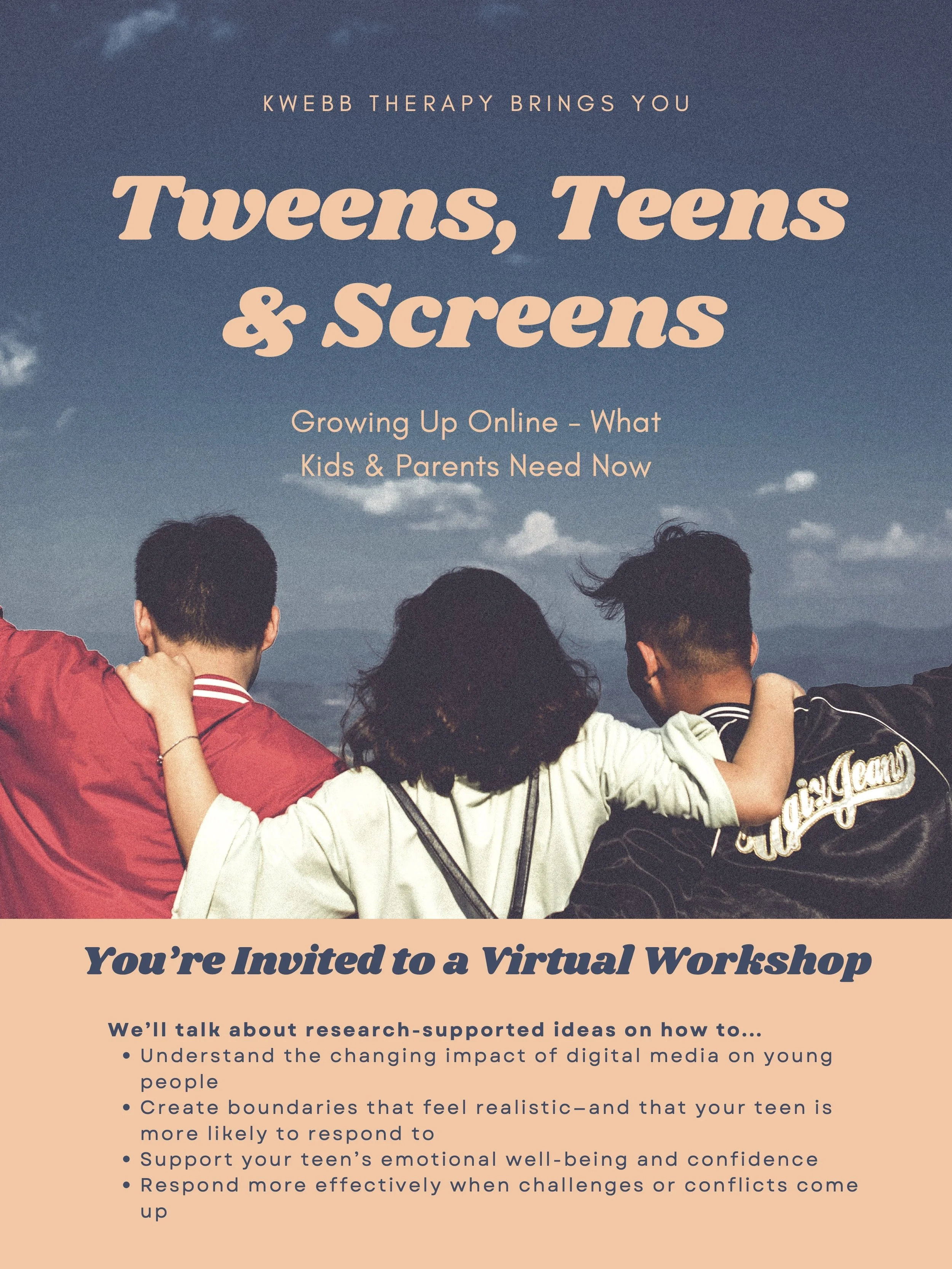
For many parents, figuring out how to approach screens and technology can feel overwhelming.
KWebb therapy is pleased to offer no-cost workshops to the community.
Click below to learn about the different presentations available.
references
Reviews.org. (n.d.). Cell phone addiction: 2026 statistics & trends. Retrieved April 20, 2026, from https://www.reviews.org/mobile/cell-phone-addiction
Agarwal, A., Arafa, M., Avidor-Reiss, T., Hamoda, T. A.-A. A.-M., & Shah, R. (2023). Citation errors in scientific research and publications: Causes, consequences, and remedies. World Journal of Men’s Health, 41(3), 461–465. https://doi.org/10.5534/wjmh.230001
Teague, S., Somoray, K., Shatte, A., Miller, D., & colleagues. (2026). Digital media use and child health and development: A systematic review and meta-analysis. JAMA Pediatrics. https://doi.org/10.1001/jamapediatrics.2026.0085
Radesky, J., & Christakis, D. A. (2016). Media and young minds. Pediatrics, 138(5), e20162591. https://doi.org/10.1542/peds.2016-2591